Rzepak+
Foliar fertilizer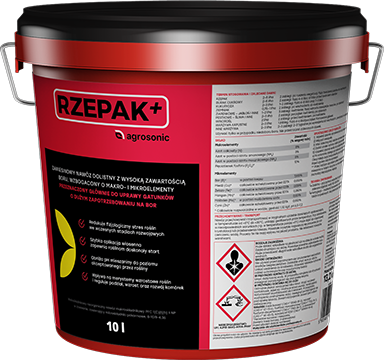
Choose a path leading to high yields
Rzepak+ is a highly concentrated mineral fertilizer with a high boron content, to be used in crops characterised by a high demand for this compound. It is enriched with macro- and micronutrients, and contains epibrassinolide. It reduces physiological stress in plants caused, for example, by insufficient moisture content or frost.
Advantages of Rzepak+
- The formulation boosts plant immunity and regeneration due to its content of a natural steroid, epibrassinolide.
- It ensures normal development of plants and increases their resistance to adverse conditions.
- Micronutrients, including copper, iron, manganese, and zinc, are fully chelated by EDTA and easily assimilated by plants.
- The high content of boron effectively uptaken by plants meets their nutritional demands, contributing to improved flowering and setting of fruit.
- Added auxiliary agents improve the product resistance to washing off.
Composition
- Nitrogen 8% (105.6 g/l)
- Phosphorus 10% (132.0 g/l)
- Boron 7% (92.4 g/l)
- Copper 0.05% (0.66 g/l)
- Iron 0.1% (1.32 g/l)
- Manganese 2% (26.4 g/l)
- Zinc 0.05% (0.66 g/l)
- Molybdenum 0.001% (0.013 g/l)
About Rzepak+
To obtain satisfactory yield, plants’ nutritional demand, including macro- and micronutrients, needs to be met. Foliar fertilizer provide the fastest way for supplying them to a plant.
Choose a path leading to high yields and fully unlock the yield potential of plants!
How and when to use Rzepak+?
| Crop | Treatment date | Number of treatments | Dose [l/ha] |
|---|---|---|---|
| Rape | after the vegetation start, from the bud formation stage until flowering | 2 | 2–5 |
| Sugar beet | at the four–six-leaf stage, shortly before inter-row closing stage | 2 | 2–5 |
| Maize | at the four–five-leaf and the seven–nine-leaf stage | 1–2 | 2–3 |
| Potato | after plants emergence until flowering | 2 | 0.75–1 |
| Fruit trees and shrubs | before and after flowering | 2–3 | 1.5–3 |
| Grapevine | before and after flowering | 2 | 2 |
| Vegetables | two–three weeks after planting or emergence; repeat the treatment every eight to ten days | 2–3 | 2–3 |
| Brassica vegetables | at the four–six-leaf stage or at the beginning of head formation | 2–3 | 2–3 |
What is epibrassinolide?

Epibrassinolide (EPIN) is a recently discovered compound that is naturally found in plants in small quantities. Its effect is based on stimulating physiological processes, and its optimum levels are crucial for the quantity and quality of obtained yield.
What is EDTA chelate?

EDTA chelating improves absorption of nutrients. Furthermore, it adjusts pH of working solution and protects micronutrients against reactions with hard water.
What is the role of boron in a plant?

Boron has many important functions in metabolic processes conducted by plants. This compound participates in construction of cell wall structures, where it is responsible for adding calcium and synthesis of hemicellulose, pectins, and lignins. It is also responsible for controlling the auxins activity, and participates in production of proteins and nucleic acids.
- By stimulating development of apical meristems, it promotes growth of roots and young stems.
- It strengthens setting and formation of plant generative organs, and this has a significant impact on a level of developing yield.
- Boron increases plant resistance to stress caused by frosts.
- It also reduces a risk of stem cracking during the intense plant growth.
- It enables more effective use of nutrients supplied with fertilizer, such as nitrogen, phosphorus, potassium, and magnesium. Furthermore, it controls calcium management.
Unfortunately, quite a large fraction (as much as 80%) of soils in Poland are characterised by its relatively low content. The soil composition is correlated with its agronomic class and content of organic material (humus). According to a general principle, the heavier the soil, the higher its boron content. Thus, usually it is light and very light soils that are deficient in this compound. For this reason, it is particularly important to supplement its deficiencies in crops with higher demand for this compound, including rape, beetroot, potato, maize, cabbage, and fruit trees. Efficient assimilation of supplied boron by plants requires appropriate soil pH. Its uptake by plants is the most efficient at pH ranging between 5.5 and 6.5. However, it should be remembered that soil liming reduces its assimilation. This compound is absorbed by plants in the form of boric acid.
Symptoms of boron deficiency manifest as atrophy of meristems, deformation and cracking of young leaves, and poorer development of flowers. In older plants, it may lead to drying of leaves and stems, and white-yellow merging spots may also appear. It causes heart rot in beetroot, and flower dropping in rape.
Excess boron may be toxic to plants. This effect manifests as browning of leaf edges. Cereals, mainly barley, and soybean plants, are particularly sensitive to this impact.
Q&A
What is the price of Rzepak+?
You can get a current price list for our products from one of our consultants. Leave your contact data using the contact form available at our website. We will get back to you shortly!
Where can you buy Rzepak+?
Are you interested in buying Rzepak+, but do not know how to order it? Complete the contact form, and one of our consultants will call you back.
How to prepare a working solution?
Prepare the working solution according to the sequence below:
- Fill a sprayer tank with water to half of its volume.
- Switch a mixer on.
- Pour in a recommended dose of well mixed fertilizer.
- Add a plant protection product (optionally)*.
- Add water to the tank to make up to the required volume.
- After treatment, wash the sprayer with water.
The solution must be used directly after its preparation.
Mix thoroughly before use.
*Before each spraying, perform a mixing test in a small vessel to ensure that no undesirable reactions occur.
Rzepak+ storage conditions
The fertilizer should be stored and transported in original, tightly sealed containers, at a temperature between 5°C and 30 °C; avoid sudden temperature changes. If stored in incorrect conditions (e.g., at a temperature below 5°C), a partial crystallisation or discolouration of the fertilizer may occur. The formed crystals will dissolve when the product is diluted with water. Those processes do not affect the product quality. Do not stack.
What is the expiry date for the Rzepak+ fertilizer?
The Rzepak+ shelf life is 36 months of the production date, provided the recommended storage conditions are observed. The expiry date is provided on the container.